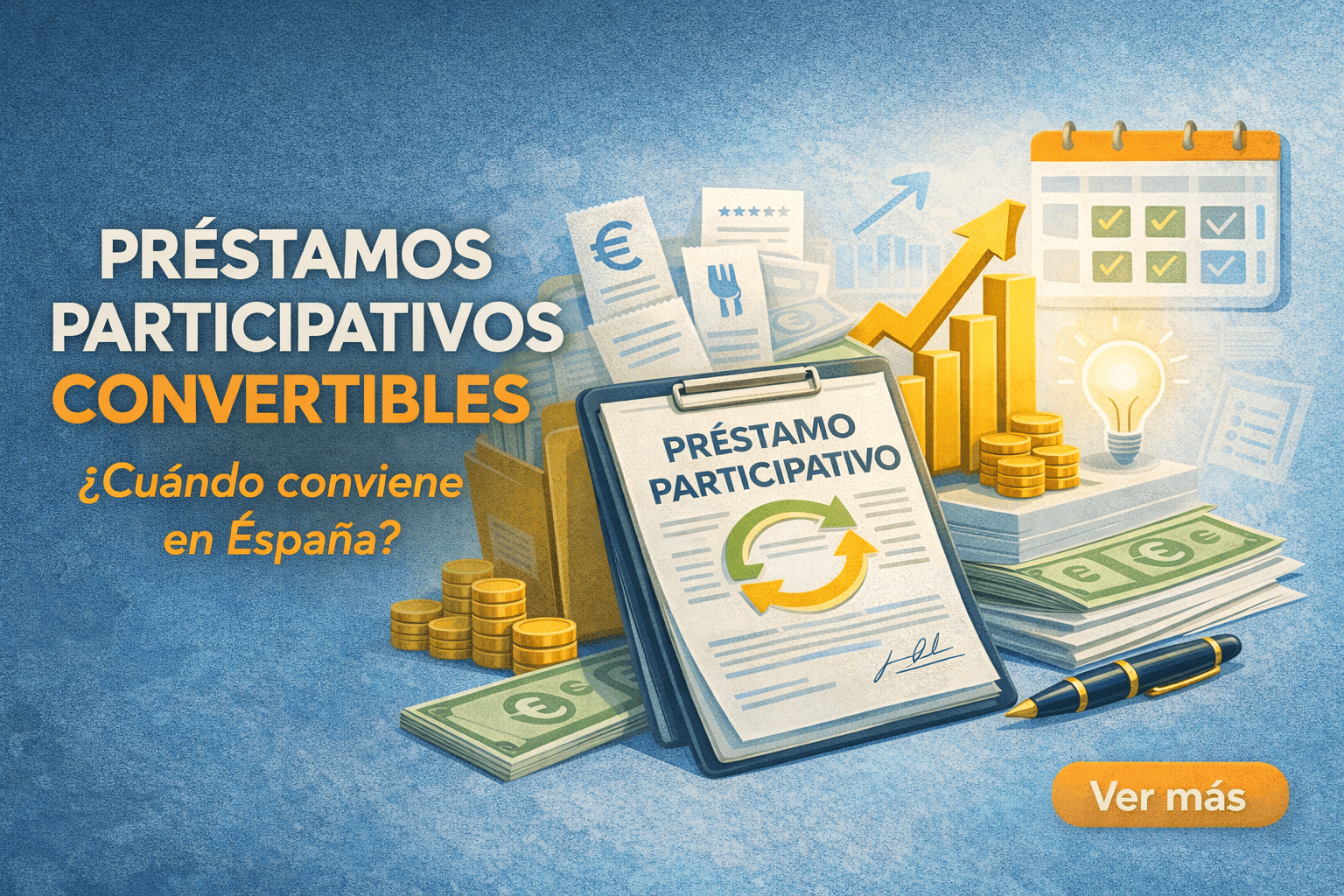
Convertible profit-participating loans in Spain: how they work in an SL, when they make sense (and when they don’t)
In Spain, “convertible” has become a catch-all word. In startup financing it can mean anything from a short bridge loan to a hybrid instrument with conversion mechanics, discounts and valuation caps. The issue is that, once you move into the legal reality of a Spanish private limited company (Sociedad Limitada, SL), many market-style structures break for one simple reason: conversion is not an idea, it is a corporate transaction that must be properly executed and registered.
The useful version (the one that actually works in an SL) is this: a profit-participating loan under Spanish law, plus a contractual mechanism to convert the credit into participations. In practice, that conversion is typically implemented through a capital increase by set-off of receivables under the Spanish Companies Act.
This article explains the concept, when it is a good solution for founders and investors in Spain, and when it can create friction, deadlock, or even a legal challenge.
What a profit-participating loan is in Spain (and what it really does)
Spanish law frames profit-participating loans in Article 20 of Royal Decree-Law 7/1996. The features that matter most for startups include:
That last item is often overstated in fundraising discussions. “Counted as equity” for those narrow corporate law purposes does not mean it becomes equity for everything. A TEAC criterion highlights that outside those specific effects, the instrument remains debt/liability. (https://serviciostelematicosext.hacienda.gob.es/teac/dyctea/criterio.aspx?id=39%2F00901%2F2022%2F00%2F0%2F1)
Key clarification for an SL: no shares, only participations (and beware “convertible bonds”)
An SL does not issue shares; it issues participaciones sociales (participations).
And there is a critical distinction:
- A convertible loan is a private loan agreement that includes a capitalisation/conversion mechanism into participations (common in startups and generally workable).
- Convertible bonds/obligations are securities issued by the company. In an SL, Spanish law expressly prohibits issuing or guaranteeing convertible obligations into participations (Article 401 LSC). (https://www.boe.es/buscar/act.php?id=BOE-A-2010-10544)
Practical takeaway: if someone proposes “convertible bonds” for an SL, it usually needs to be reframed as a loan with a conversion clause.
How conversion really happens in an SL: capital increase by set-off of receivables (Article 301 LSC)
In practice, converting a loan into participations in an SL is typically implemented through a capital increase by set-off of receivables. The legal anchor is Article 301 of the Spanish Companies Act (LSC), which sets two decisive requirements:
- In an SL, the receivables to be set off must be fully liquid and due (exigible). (https://www.boe.es/buscar/act.php?id=BOE-A-2010-10544)
- The shareholders’ meeting must have access to a directors’ report describing the receivables, identifying contributors and detailing the capital increase, consistent with the company’s accounting records. (https://www.boe.es/buscar/act.php?id=BOE-A-2010-10544)
This drives the most important drafting advice: if you want a “convertible” that is actually executable, the agreement must ensure the credit becomes due at the conversion trigger and that the amount is determinable without dispute. If the agreement leaves grey areas (capitalised interest, premia, ambiguous triggers), conversion becomes a negotiation under stress.
Dilution and pre-emptive rights: what happens (and why it matters)
Pre-emptive rights in the LSC are linked to capital increases funded by cash contributions (Article 304 LSC). (https://www.boe.es/buscar/act.php?id=BOE-A-2010-10544)
A conversion through set-off of receivables is not a standard cash contribution, and Spanish registry practice distinguishes these scenarios. The DGSJFP Resolution of 7 February 2020 discusses this and highlights that pre-emptive protection is preserved in cash-funded increases, differentiating them from set-off mechanisms. (https://www.boe.es/diario_boe/txt.php?id=BOE-A-2020-6793)
Practical effect: conversion can dilute existing shareholders without the same “safety net” they would have in a classic cash increase. If there are meaningful minorities or a sensitive cap table, governance alignment (bylaws/shareholder agreement, voting commitments and clear information rules) becomes essential.
The point you can’t ignore: challenge risk based on abuse of majority
A formally valid conversion is not automatically immune from challenge. The Companies Act allows challenges where resolutions harm the corporate interest in favour of one or more shareholders, and frames abusive majority behaviour (Article 204 LSC). (https://www.boe.es/buscar/act.php?id=BOE-A-2010-10544)
The 7/2/2020 DGSJFP resolution itself reminds that parties who consider themselves harmed may pursue judicial challenge in the corporate framework. (https://www.boe.es/diario_boe/txt.php?id=BOE-A-2020-6793)
This became particularly relevant with Spanish Supreme Court judgment STS 1763/2025 (2 December 2025, ECLI:ES:TS:2025:5428), which analyses a capital increase by set-off of receivables and confirms nullity for abuse of majority in a context of intense minority dilution. (https://www.elnotario.es/images/pdf/STS-N125-07.pdf)
The takeaway is not “never use set-off conversion”. The takeaway is: if conversion is used as a lever to impose an unjustified dilution, or if less harmful alternatives existed, litigation risk increases substantially.
When it is usually a good fit for startups in Spain
A convertible profit-participating loan tends to work well when:
- You need bridge financing and want to postpone valuation discussions until a qualified round.
- There is a realistic probability the conversion trigger will happen (round/milestone/exit) within the expected timeline.
- You want a performance-aligned instrument (variable interest) and the specific corporate law effects of the profit-participating structure, without treating it as “equity in disguise” for all purposes. (https://www.boe.es/buscar/act.php?id=BOE-A-1996-13002)
In short, it can buy time and reduce friction today while keeping a clear path to equity later.
When it does not fit (or requires redesign)
It often becomes a poor fit (or needs more engineering) when:
Accounting and tax: the minimum you should understand
From an accounting perspective, ICAC has stated that profit-participating loans are accounted for under the ordinary financial instruments rules of the Spanish PGC. (https://www.icac.gob.es/sites/default/files/2020-11/BOICAC_54_0603_2.PDF)
ICAC has also addressed the accounting treatment of capital increases by set-off of receivables from both lender and borrower perspectives (BOICAC 89/2012). (https://www.icac.gob.es/sites/default/files/2020-11/BOICAC_89_0312_4.PDF)
On tax, when debt is capitalised, the Spanish tax authority highlights valuation rules in corporate tax: the operation is valued for tax purposes by the mercantile increase amount (Article 17.2 LIS) and adjustments may apply (Article 17.5 LIS). (https://sede.agenciatributaria.gob.es/Sede/ayuda/manuales-videos-folletos/manuales-practicos/manual-sociedades-2020/capitulo-5-liquidacion-is-determinacion-imponible/bi-antes-reserva-capitalizac-compensac-00550/detalle-correcc-result-cuenta-perdidas-is/reglas-valoracion/operaciones-aumento-capital-fondos-prop-creditos.html)
For most startup readers, the practical message is enough: accounting and tax can diverge, and capitalised interest/premia should be reviewed carefully before signing.
How to structure it properly (without overcomplicating the contract)
The goal is not a long document; it is an executable one. In Spain, a well-structured convertible profit-participating loan typically ensures:
- A clear trigger (what activates conversion, how it is verified, and what happens if it doesn’t occur).
- A clear conversion price (discount, valuation cap, or another formula), avoiding ambiguous definitions.
- An execution-ready corporate mechanism: the credit is liquid and due at conversion (Article 301 LSC), documentation is aligned, and bylaws/shareholder agreement do not turn the shareholders’ meeting into a battlefield. (https://www.boe.es/buscar/act.php?id=BOE-A-2010-10544)
FAQ
In an SL, does conversion result in shares or participations?
In an SL, conversion results in participaciones sociales. Shares belong to an SA.
Can an SL issue convertible bonds?
No. The LSC prohibits an SL from issuing or guaranteeing convertible obligations into participations. (https://www.boe.es/buscar/act.php?id=BOE-A-2010-10544)
How is conversion executed in an SL?
Typically through a capital increase by set-off of receivables. In an SL the receivable must be fully liquid and due, and a directors’ report is required. (https://www.boe.es/buscar/act.php?id=BOE-A-2010-10544)
Are there pre-emptive rights in a conversion by set-off?
Article 304 LSC links pre-emptive rights to cash-funded increases, and registry practice distinguishes set-off conversions from that model. (https://www.boe.es/buscar/act.php?id=BOE-A-2010-10544)
Can a conversion be challenged if it heavily dilutes a minority?
Yes. Article 204 LSC frames abusive majority conduct, and recent Supreme Court case law has examined set-off increases with strong dilutive effects through that lens. (https://www.boe.es/buscar/act.php?id=BOE-A-2010-10544)
Does a profit-participating loan count as equity?
Only for specific corporate law purposes (capital reduction and liquidation tests). Outside that, it remains debt/liability. (https://www.boe.es/buscar/act.php?id=BOE-A-1996-13002)
Need help?
At Legal Core Labs we help startups in Spain structure convertible profit-participating loans so they are actually executable in an SL (Article 301 mechanics, alignment with bylaws/shareholder agreements, and prevention of dilution conflicts), ensuring financing accelerates the business instead of blocking it at conversion.