Commercial Contracts to Scale a Startup: What to Sign and When
Agency, distribution, SaaS and partnership agreements: learn which commercial contracts startups need to scale safely in Spain and the EU, and how to avoid legal risks.
Read more →
In a Spanish private limited company (Sociedad Limitada, SL), voting thresholds are not a formality. They determine who truly controls corporate decisions, what can be executed without consensus, and how real-life risks (gridlock, investor disputes, forced exits) are managed when the company is under pressure.
If you are drafting (or renegotiating) bylaws and a shareholder agreement, you need a clear map to (1) keep decision-making fast, (2) protect minority investors without giving away “free” veto power, and (3) reduce the risk of challenges based on invalid procedure or abusive majority conduct.
Main legal source: Spanish Companies Act (Ley de Sociedades de Capital, LSC) (SL).
Consolidated text (Spanish): https://www.boe.es/buscar/act.php?id=BOE-A-2010-10544
The SL default rule is based on votes validly cast (yes vs no), with an important practical safeguard: the “yes” votes must represent at least a minimum fraction of the share capital in accordance with the SL rules in the LSC (and blank votes are not counted).
Two practical takeaways:
Everyday resolutions typically pass with more votes in favour than against, subject to the SL statutory baseline for the “yes” votes (and excluding blank votes).
Share capital: A 60%, B 25%, C 15%.
The LSC imposes higher thresholds for decisions with structural impact. In SL practice, two levels matter most: over 50% of the share capital and 2/3 of the share capital for specific matters.
With 51%, a shareholder can pass a bylaw amendment alone (if they vote yes). With 50/50, the amendment is blocked.
Common “high impact” decisions include:
A 34% investor can block decisions requiring a 2/3 majority by preventing the threshold from being reached. This often affects M&A, reorganisations, exclusions, and certain capital operations.
SL bylaws can require higher thresholds than the legal minimum, and can even add an extra condition such as approval by a minimum number of shareholders (headcount requirement). However, there is a key boundary: you cannot impose unanimity as a general voting rule.
Also, certain matters have specific limits. For example, in an SL you may strengthen the voting threshold for removal of directors, but not above 2/3.
Practically, these rules can turn a 25%-30% stake into a de facto veto if the bylaw thresholds are raised too aggressively.
Minority protection is not only about blocking by qualified majority. The LSC grants concrete rights at key ownership thresholds.
As a general rule, shareholders holding at least 1% may challenge corporate resolutions (with exceptions for public policy issues). Bylaws may reduce this threshold.
Crucially, a breach of a shareholder agreement does not automatically invalidate a corporate resolution if the resolution complies with law and bylaws. Challenges typically need to be framed as (1) illegality or bylaw breach, or (2) abusive majority conduct harming the corporate interest.
At 5%, shareholders can often:
In practice, 5% is frequently the threshold that changes negotiation dynamics in founder and investor disputes.
Under certain conditions, Article 348 bis LSC may enable a dissenting shareholder to claim an exit right (separation right) where distributable profits exist but the meeting repeatedly refuses to approve a minimum distribution required by the statute’s conditions.
This is not a direct “right to force dividends” in all situations, but it is a meaningful exit and pressure tool where majority shareholders indefinitely prioritise reinvestment.
If bylaws require 2/3 but the shareholder agreement requires 80% for “selling the company”:
A shareholder agreement without enforcement tools often fails precisely when the company is under stress. Mechanisms that typically work (and can be combined):
The practical point is to create incentives to comply, rather than incentives to litigate.
A resolution can fail even without meaningful opposition if the statutory baseline is not met.
Requires a bylaw amendment (over 50%). Once in bylaws, thresholds can be raised for future decisions.
That stake can block 2/3 decisions (merger, transformation, pre-emptive right limitation, exclusion). If you accept this, you should offset it with governance architecture and exit routes.
In an SL, removal is possible, but bylaw reinforcement has limits (do not exceed 2/3).
At 5%, the notarial record requirement can materially change the evidentiary landscape.
348 bis can lead to separation rights under statutory conditions (and bylaws may modulate within legal boundaries).
Ordinary matters generally pass with more “yes” than “no” votes among validly cast votes, subject to the SL statutory baseline and any qualified majority rules for specific matters.
Typical examples include capital increases or reductions and bylaw amendments.
For high-impact matters such as director competition dispensations, waivers or limitations of pre-emptive rights in certain scenarios, transformations, mergers, splits, global transfers, and shareholder exclusions.
You can increase thresholds without reaching unanimity and subject to specific limits for certain matters (for example, director removal in an SL cannot be reinforced beyond 2/3).
It does not change corporate validity by itself. It binds signatories contractually and should be backed by penalties, options and other remedies. If you need it to be binding as a corporate rule, it belongs in the bylaws.
Commonly, 5% (subject to statutory conditions).
As a general rule, 1% (with exceptions). Bylaws may reduce the threshold.
Need help designing a fast, enforceable governance structure for your SL in Spain? At Legal Core Labs we support founders and investors with bylaw architecture, reserved matters, shareholder agreement enforcement and minority protection, with a practical approach tailored to startups and tech companies.
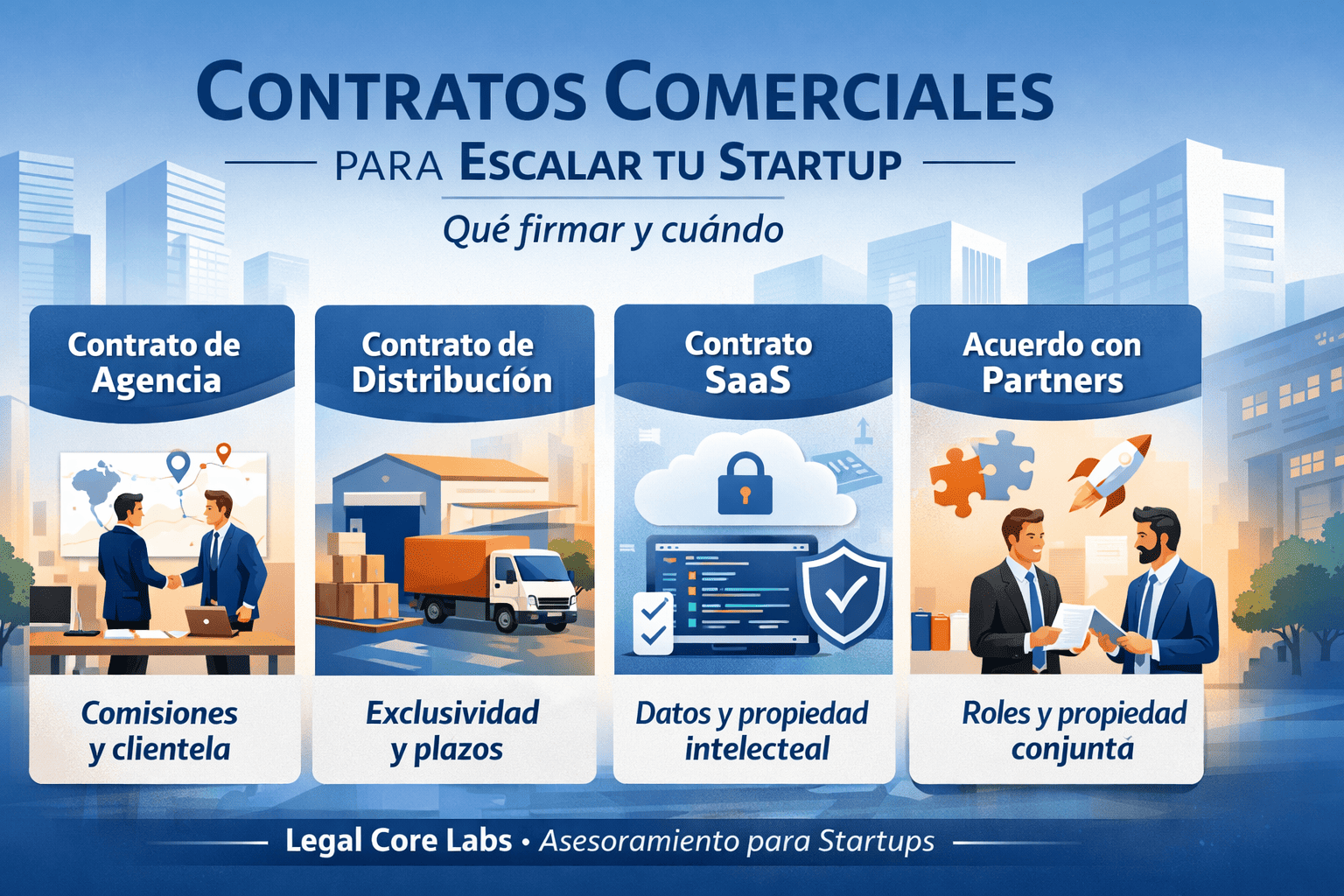
Agency, distribution, SaaS and partnership agreements: learn which commercial contracts startups need to scale safely in Spain and the EU, and how to avoid legal risks.
Read more →
Practical guide to LOIs in Spain (startups and M&A): legal nature, exclusivity, confidentiality, timeline, what happens if the deal does not close, and what happens if the LOI is breached
Read more →
practical guide for startups in Spain: reminder of prior obligations, 2025 criteria on banners, granular consent, personalization, consentless audience measurement, the “pay or okay” model, and effective withdrawal of consent.
Read more →