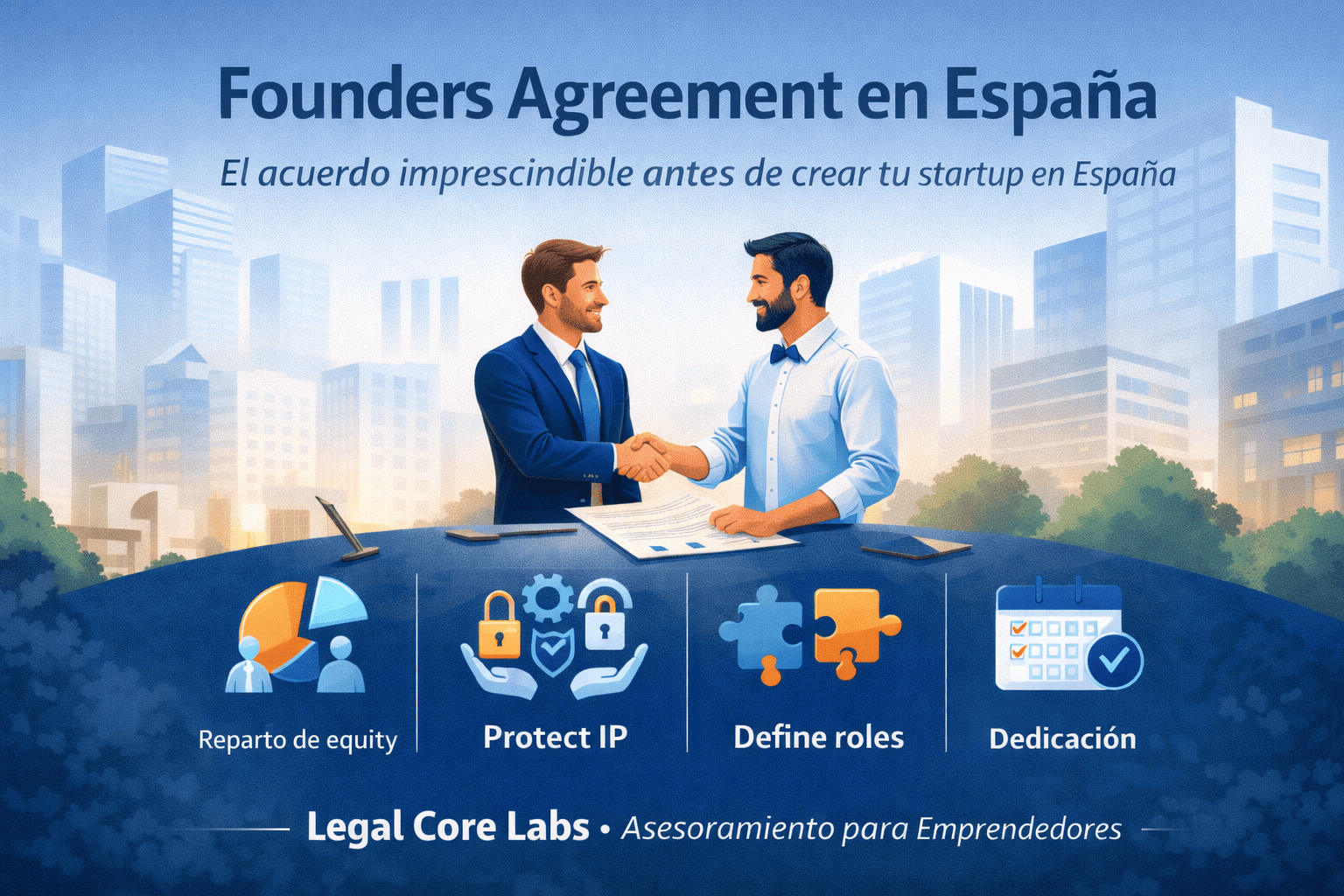
Founders Agreement: the key agreement between founders before launching a startup in Spain
Starting a startup with one or more co-founders is exciting, but it is also one of the most sensitive stages from a legal perspective. Even before incorporating a limited liability company, there is a document that can determine whether the project scales smoothly or ends in internal conflict: the Founders Agreement.
In this article, we explain what a Founders Agreement is, why it should be signed before incorporation, what it should regulate under Spanish law, and how it helps prevent the most common founder disputes across all types of startups.
What is a Founders Agreement and why does it matter?
A Founders Agreement is a private contract signed by the founders of a business project at a pre-incorporation stage. Its main purpose is to establish clear rules when there are still no shares, bylaws or corporate structure in place.
Unlike company bylaws or a traditional shareholders’ agreement, this document focuses on the very beginning of the project, when key elements are still being defined: contributions, commitment, intellectual property and long-term expectations.
In practice, it is the document that brings legal order to a startup before it starts growing.
Why it should be signed before incorporation
One of the most common mistakes among founders is postponing these discussions. From a legal and strategic standpoint, this is risky.
Signing a Founders Agreement before incorporating allows founders to anticipate conflicts and avoid structural problems such as poorly designed equity splits, founders leaving early while keeping significant ownership, or disputes over who owns the technology, brand or know-how.
It also places the startup in a stronger position when approaching investors, as it demonstrates that the project has been properly structured from the outset.
Key elements of a Founders Agreement under Spanish law
While every startup is different, certain sections should always be included in a well-drafted Founders Agreement in Spain.
Equity allocation and vesting
The agreement should define how ownership is distributed among founders, not only in percentages but also in terms of conditions.
In the startup ecosystem, vesting mechanisms are commonly used so that equity is earned over time through continued involvement. This prevents situations where a founder exits early but retains a meaningful stake in the company.
Commitment, time dedication and exclusivity
Not all founders contribute equally. The agreement should clearly state the level of dedication expected from each founder, whether exclusivity applies, and what happens if a founder reduces their involvement without justification.
This is especially relevant for startups aiming for fast growth or external investment.
Intellectual property and founder contributions
Intellectual property is one of the most sensitive issues in early-stage startups. Source code, designs, databases, trademarks and know-how must be properly allocated from the beginning.
The Founders Agreement should ensure that all developments created within the project belong to the business and not to individual founders. It should also define the nature and conditions of any initial contributions made by each founder.
Roles, responsibilities and decision-making
While startups require flexibility, defining roles reduces friction. The agreement typically outlines each founder’s main responsibilities and establishes basic decision-making rules for strategic matters.
This does not prevent future changes but helps avoid power struggles and operational confusion.
Confidentiality and non-compete obligations
Protecting sensitive information is essential from day one. Founders Agreements usually include confidentiality obligations and, where appropriate, non-compete clauses aligned with Spanish legal requirements.
Such restrictions must be proportionate in scope and duration to remain enforceable.
Founder exits and conflict resolution
Change is inevitable in any startup. The agreement should anticipate potential exits, define the conditions under which a founder can leave, and regulate the treatment of their equity and rights.
Addressing these scenarios early avoids rushed decisions when relationships deteriorate.
Legal framework of a Founders Agreement in Spain
From a legal perspective, a Founders Agreement is based on the principle of freedom of contract under the Spanish Civil Code. It is a valid and binding private contract between its signatories.
However, it must later be aligned with the company’s bylaws and any shareholders’ agreement once the company is incorporated, to avoid internal inconsistencies.
Why legal advice matters from the beginning
Although generic templates exist, each startup faces different risks depending on its sector, business model and growth strategy. A poorly drafted Founders Agreement can create more problems than it solves.
Proper legal advice ensures that the agreement reflects the reality of the project and complies with Spanish law, laying solid foundations for future growth.
At Legal Core Labs, we help founders structure these agreements with both legal precision and strategic vision, preventing common mistakes that can compromise a startup’s future.
Frequently asked questions about Founders Agreements
Is a Founders Agreement mandatory in Spain?
No, it is not legally mandatory, but it is strongly recommended. Most founder disputes arise from the absence of early agreements.
Does it replace a shareholders’ agreement?
No. A Founders Agreement is signed before incorporation and usually serves as the basis for a later shareholders’ agreement.
Is it legally enforceable?
Yes. It is a valid and enforceable private contract between the founders who sign it.
What happens if a founder leaves without an agreement?
Without a prior agreement, a founder’s exit can cause deadlocks, equity disputes or intellectual property conflicts.
Can it be amended later?
Yes, as long as all founders agree. In fact, it is advisable to review it as the project evolves.