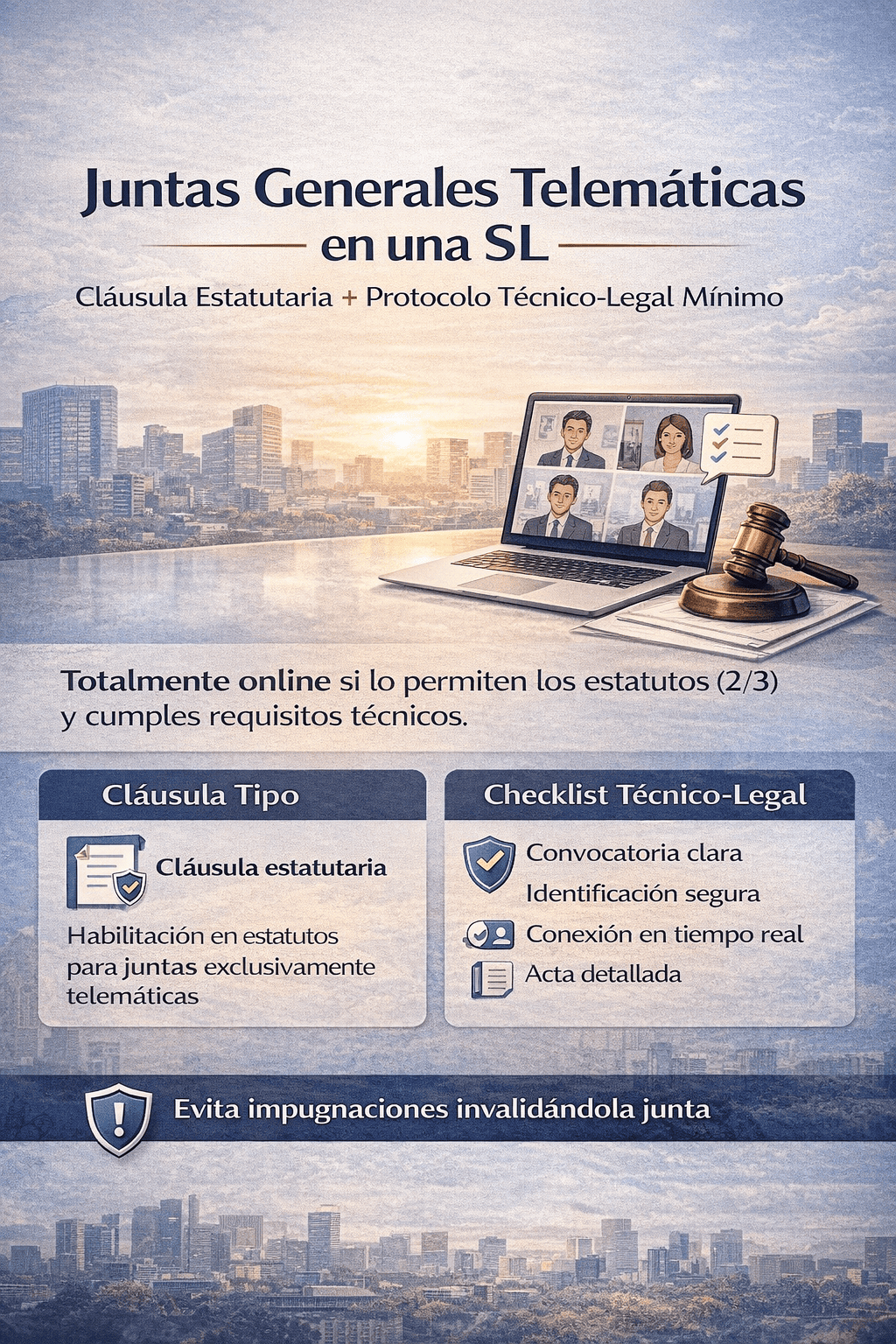
Fully Online General Meetings in a Spanish SL: how to do it right (statutory clause, checklist and legal-technical protocol)
Fully online general meetings are one of the most effective ways for startups and SMEs to streamline corporate governance: approving annual accounts, formalising capital increases, appointing directors or authorising key transactions without having everyone in the same room.
However, “holding a meeting via video call” is not the same as “holding a legally valid general meeting”.
In Spain, fully online general meetings (without any physical attendance) are subject to specific legal requirements. If these are not met, resolutions may be challenged or even declared void, which is particularly problematic when the agreements are strategic (funding rounds, amendments to bylaws, management changes, related-party transactions, etc.).
This guide provides a practical and complete overview: when an SL can hold a fully online meeting, whether bylaws must be amended, what the notice of meeting must include, how to verify identities, what minimum protocol should be followed, and an example of a statutory clause. A FAQ section is included at the end.
1. What is a “fully online” general meeting and why the distinction matters
From a legal perspective, three scenarios must be distinguished:
- Physical meeting: a physical place of meeting exists.
- Hybrid meeting: a physical place exists, but some shareholders attend remotely.
- Fully online meeting: no physical attendance at all; the meeting is held entirely online.
This article focuses mainly on the fully online meeting, which is the most demanding in formal terms, as it eliminates the physical venue and requires technological safeguards to ensure shareholders’ rights.
2. Key rule: in an SL, a fully online meeting requires express statutory authorisation
For Spanish private limited companies (Sociedades Limitadas), the practical rule is clear:
If the bylaws do not expressly allow fully online general meetings, they should not be convened in that form.
Although Spanish law allows online meetings, their use is generally conditional on the existence of a specific statutory clause authorising them. This has two direct consequences:
- If you want to regularly hold meetings fully online, you will normally need to amend the bylaws.
- If amending the bylaws is not possible (for example, due to lack of the required majority), a physical or hybrid meeting may be the safer alternative.
Majority required to introduce the clause
Introducing a clause allowing fully online meetings usually requires a reinforced majority at the meeting approving the amendment. In practice, it is advisable to approach this as a governance improvement and seek broad consensus, especially where minority shareholders or investors are involved.
3. Real advantages for startups (and when caution is advisable)
A properly structured online meeting adds value where:
- Shareholders are located in different cities or countries.
- Investors, advisors or directors have limited availability.
- Decisions must be formalised quickly (funding rounds, ESOP/phantom plans, management changes).
- The company operates with a distributed or digital-first culture.
Situations where extra caution is required:
- When serious shareholder conflict is anticipated.
- Where shareholders lack reasonable technical means or digital literacy.
- For particularly sensitive resolutions where maximum evidentiary certainty is desired (in some cases, a notarial record may be advisable).
4. The legal minimum: what a fully online meeting must guarantee
An online general meeting cannot be reduced to a mere broadcast. It must allow shareholders to effectively exercise their corporate rights.
Rights that must be effectively ensured
At a minimum, the system must allow shareholders to:
- Identify themselves and prove their entitlement (as shareholder or proxy).
- Participate actively (right to speak).
- Request information (right to information, within legal limits).
- Make proposals, where applicable under the agenda.
- Vote, in a reliable and verifiable manner.
A key requirement applies throughout:
Real-time participation and two-way communication.
If a shareholder cannot effectively intervene or vote due to the system used, the risk of challenge increases significantly.
5. Is a bylaw amendment also required for hybrid meetings?
This depends on hookup of your bylaws and whether they already allow remote attendance.
- For fully online meetings, an express statutory clause is generally required.
- For hybrid meetings, statutory coverage is also advisable. For legal certainty, it is best to regulate both modalities clearly or at least grant the management body express authority.
6. Sample statutory clause (illustrative)
Below is an example of a commonly used and flexible clause for an SL, avoiding excessive technical rigidity:
Clause (Fully Online General Meetings)
“The General Meeting may be held on a fully online basis, without physical attendance by shareholders or their representatives, when so decided by the management body in the notice of meeting, provided that the identity and legitimacy of attendees are duly guaranteed and effective real-time participation is enabled through two-way communication, allowing the exercise of rights of information, intervention, proposal and vote. For legal purposes, the meeting shall be deemed to be held at the registered office.”
Practical tip: avoid overly detailed bylaws referring to specific platforms or technologies. It is preferable to authorise the modality in the bylaws and define technical details in the notice of meeting and internal protocols.
7. Notice of meeting: essential elements
For a fully online meeting, the notice must be operational and clear. Merely stating the date and agenda is not enough.
What the notice should include in practice
- Clear statement that the meeting will be fully online.
- Date and time, with a recommendation to connect in advance.
- Platform or access method (link, ID, password, dial-in).
- Identification procedure for shareholders and proxies.
- Registration process and attendance list.
- Explanation of how rights will be exercised (speaking, questions, voting).
- Technical support channel (email or phone).
- Rules of conduct (speaking turns, chat use, etc.).
- Contingency plan in case of technical failure.
Avoid unnecessary or excessive requirements that could hinder access. Systems perceived as obstructive increase litigation risk.
8. Minimum legal-technical protocol
Beyond formal compliance, the smart approach is to document compliance. This is the real safeguard.
Step 1. Preparation (before convening)
- Review bylaws (online meeting clause).
- Select and test the platform (stability, access control, interaction tools).
- Define identification method (ID via camera, certificate, token, etc.).
- Prepare a simple participation guide for shareholders.
- Decide voting method (oral roll-call, controlled chat, polls).
- Assign technical support (person and channel).
Step 2. Opening the meeting
- Identify each shareholder or proxy.
- Confirm shareholdings or representation.
- Prepare attendance list and capital present/represented.
- Declare valid constitution of the meeting.
- Remind participants of rules for speaking and voting.
Step 3. Conduct of the meeting
- Manage speaking turns in an orderly manner.
- Record questions and responses.
- Ensure clear voting procedures.
- Address technical incidents (reasonable pauses, documentation).
Step 4. Minutes
- Record the system used, identification method, incidents and voting results.
- Attach evidence where appropriate (attendance list, logs, voting records).
- For sensitive meetings, consider a notarial record or robust documentary evidence.
9. Common risk points leading to challenges
The most frequent weak points are:
- Absence of statutory authorisation.
- Weak identification procedures.
- Limited interaction or inability to exercise rights.
- Technical failures affecting participation.
- Inadequate notice of meeting.
- Poorly drafted or incomplete minutes.
In startups, these issues often surface during due diligence or at signing stages.
10. Final checklist
Before convening:
- Bylaws authorise fully online meetings.
- Bylaw amendment registered, if applicable.
- Platform selected and tested.
- Identification and voting systems defined.
- Technical support arranged.
In the notice:
- Explicit reference to fully online format.
- Clears instructions for access, identification and voting.
- Procedure for attendance list.
- Rules for participation and information rights.
- Contingency measures.
During the meeting:
- Identification and attendance recording.
- Real-time, two-way participation ensured.
- Verifiable voting.
- Incidents documented.
Minutes:
- System used, identification, incidents and results recorded.
- Supporting evidence attached where appropriate.
FAQ: Frequently asked questions about fully online general meetings in Spanish SLs
1) Can an SL hold fully online general meetings in Spain?
Yes, provided the bylaws expressly allow it and identity, real-time participation and shareholders’ rights are guaranteed.
2) If my bylaws are silent, can I still convene a fully online meeting?
It is not advisable. The safer approach is to amend the bylaws first or to hold a physical or hybrid meeting where allowed.
3) Must the director be physically present at the registered office?
No. For legal purposes, the meeting is deemed held at the registered office even if all participants connect remotely.
4) What if a shareholder loses connection during voting?
If this prevents the exercise of voting rights, the risk of challenge increases. The prudent approach is to pause, allow reconnection and record the incident.
5) How can shareholder identity be verified?
Examples include showing ID on camera, digital certificates, individual access codes or tokens. The key is reliability and traceability.
6) Is voting via chat valid?
Yes, if the shareholder can be clearly identified and a record is kept. For sensitive resolutions, combining methods is advisable.
7) Is a notary required to record the minutes?
Not in all cases. It is a strategic decision. For contentious or high-impact resolutions, a notarial record can significantly increase legal certainty.
8) What is the difference between hybrid and fully online meetings?
Hybrid meetings have a physical venue with remote attendance allowed. Fully online meetings have no physical attendance at all and generally require stricter safeguards.
9) Can the meeting be recorded?
Yes, but participants should be informed in advance and data protection rules must be respected (purpose, access, retention).
10) Which resolutions are most sensitive if formalities are flawed?
Capital increases, bylaw amendments, appointments and removals, approval of accounts in contentious contexts, related-party transactions and resolutions affecting minority shareholders.