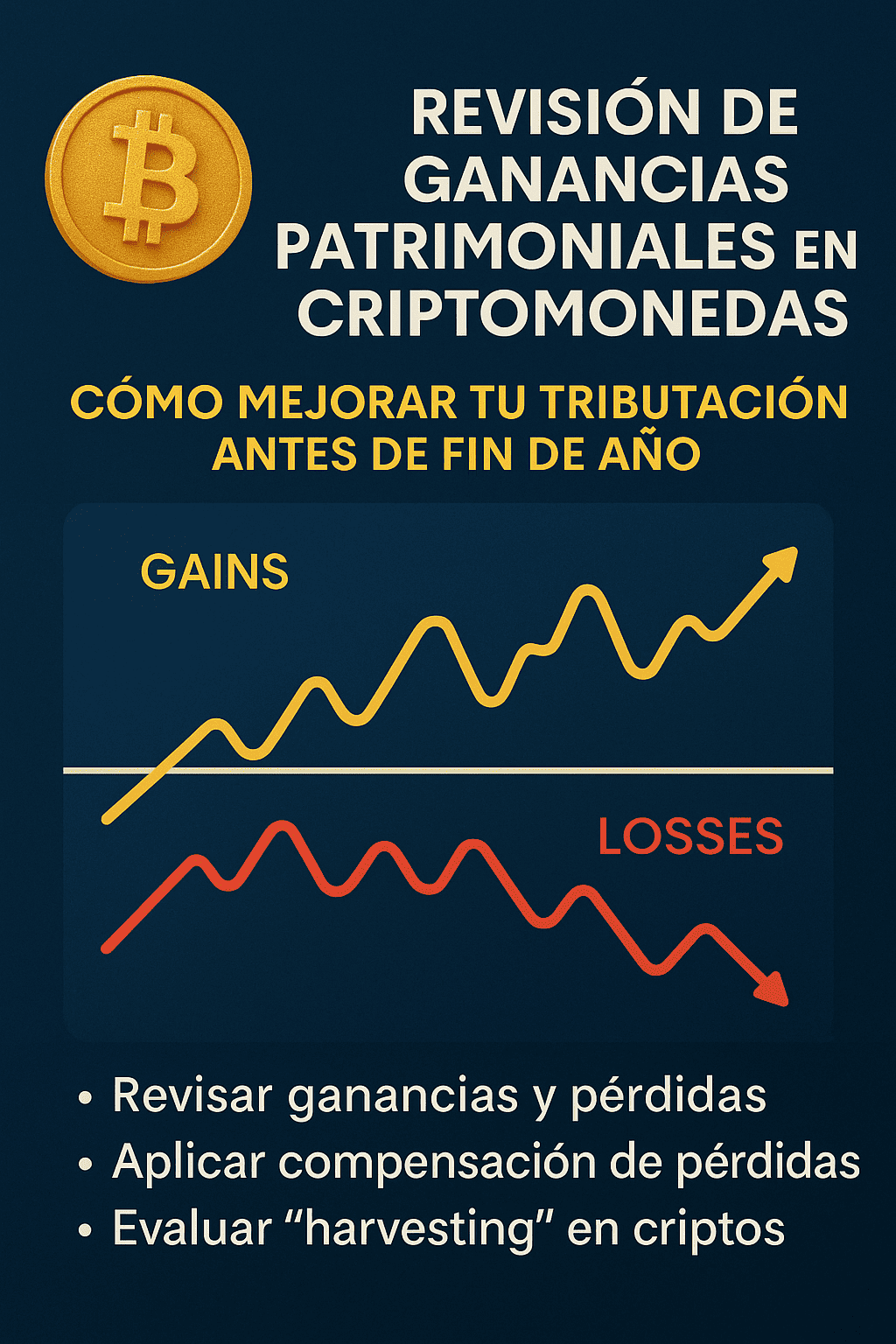
Tax Loss Harvesting in Cryptocurrencies: Turning Losses into Tax Savings
The cryptocurrency market is famous for its volatility. While this creates opportunities for significant gains, it also inevitably generates losses. Tax Loss Harvesting (TLH) is a key strategy that turns those unrealised losses into a tangible tax advantage, allowing investors to optimise their net returns.
💎 What is Tax Loss Harvesting?
TLH is a wealth management technique designed to reduce the taxable base on which taxes are calculated. In essence, it involves three steps:
- Identifying assets (cryptocurrencies) whose current market value is lower than their acquisition cost (unrealised losses).
- Selling those assets before the end of the tax year to realise the loss.
- Offsetting capital gains obtained from other disposals (cryptocurrencies, stocks, etc.) with those realised losses, thereby reducing the net taxable gain.
✅ Key advantages of harvesting
TLH is not only about cutting one year’s tax bill; it is a powerful tool that offers both short and long-term benefits.
1. Immediate reduction of taxes
The primary benefit is a direct reduction of the taxable base for personal income tax. By reducing net gains through loss offsetting, the investor reduces the capital subject to tax in the savings base. This results in real financial savings that can be retained and reinvested.
2. Maintaining market exposure (with caution)
In traditional investing, a key limitation is the so-called wash sale rule. In the crypto space, Spanish law applies a “homogeneous assets” rule and requires a two-month period without repurchase in order to offset the loss in the same year, but TLH is still useful:
- For the long term: if an asset no longer fits the investor’s strategy, selling it at a loss and using that loss is purely beneficial.
- For future offsetting: even if the two-month window is not respected, the loss is not cancelled; its offsetting is deferred until the repurchased units are sold, which allows for deferred tax planning.
3. Cross-compensation of gains
In Spain, if capital losses exceed gains in the savings base, the negative balance may be used to offset up to 25 % of positive investment income (interest, dividends, etc.). This turns crypto losses into a multi-purpose tax shield.
4. Building a negative balance for the future
Any excess losses that cannot be offset in the current year may be carried forward and used over the next four tax years to offset future gains. The investor effectively creates a “loss reserve” that will protect them from taxes in years of strong market growth.
🗺️ The essential need for tax planning
Tax Loss Harvesting cannot be a last-minute decision. It requires careful planning to be effective and compliant, especially in Spain.
1. Understanding the two-month rule
Strict application of the two-month rule before and after the loss-making sale is the critical point for harvesting in Spain. If these 60 days are not respected, loss offsetting is deferred, which eliminates the immediate benefit that TLH seeks.
Required planning: the investor must decide both the sale and any potential repurchase more than two months before the fiscal year-end (usually 31 December) if they want the loss to be effective in that same year.
2. Accurate calculation of the cost basis
To determine whether there is a real loss (and its amount), the investor must know precisely the acquisition cost of each unit of cryptocurrency sold, using valuation methods such as FIFO (First In, First Out) or weighted average cost, as applicable. Specialised accounting tools are crucial to avoid errors that could invalidate the deduction.
3. Assessing the annual tax position
Good planning involves estimating total gains and losses for the year. This allows the investor to “harvest” exactly the amount of losses needed to match gains and achieve a near-zero net tax, without generating excessive losses unnecessarily.
Conclusion
Tax Loss Harvesting is, at its core, the discipline of taking control of your tax position instead of just reacting to it. Because it is a strategy that requires timing and regulatory awareness (the two-month rule in Spain is a clear example), proactive tax planning is not optional: it is the essential prerequisite for turning market downturns into a protective shield against your tax bill.