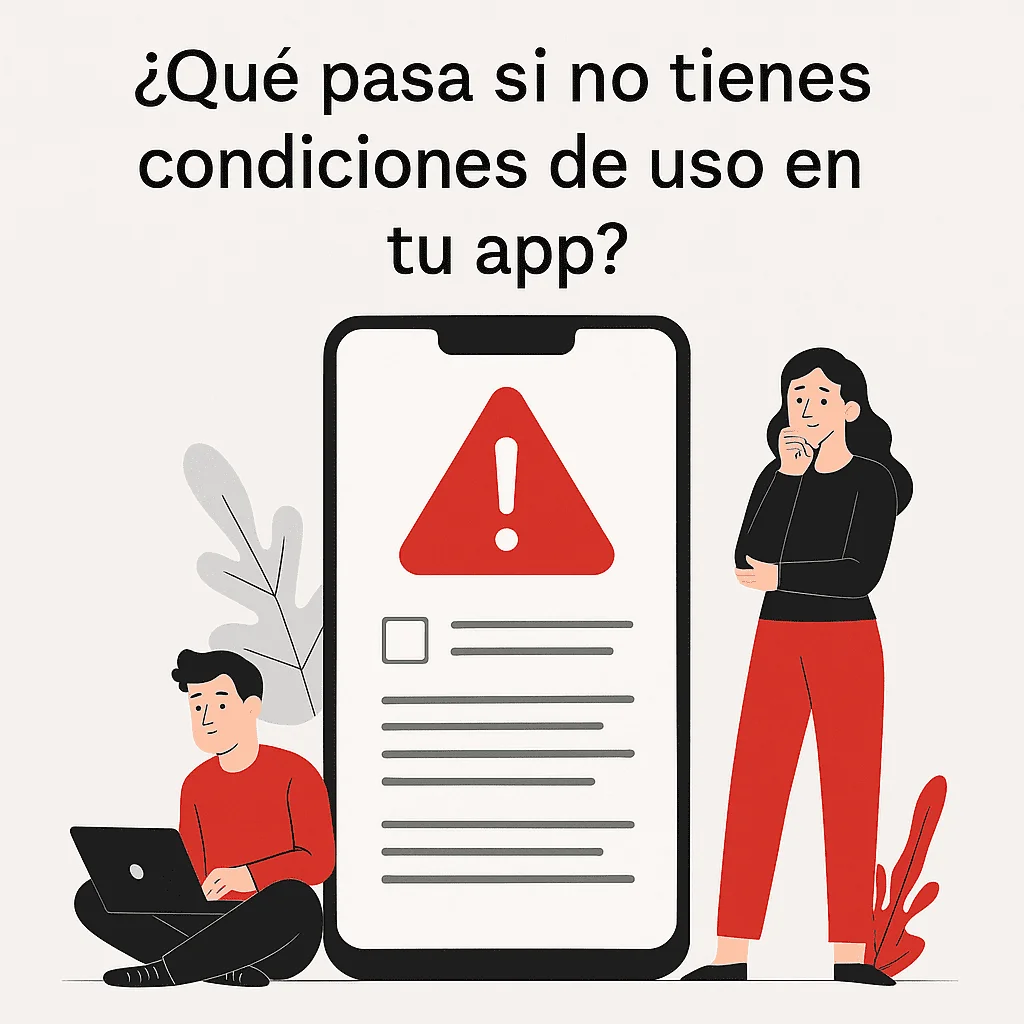
What Happens If You Don’t Have Terms of Use for Your App?
The Legal Risk of Launching Without Protecting Your Platform
Developing an app is a major milestone for any tech startup. But in the rush to launch as soon as possible, many founders overlook what legally protects the use of their application: the terms of use.
Although they may seem like a mere formality, the terms of use are a binding contract between your company and its users. Not having them — or having poorly drafted ones — can leave you completely unprotected against claims, disputes, or misuse.
In this article, we explain why terms of use are essential, what they must include, and what legal consequences you could face if you don’t have them.
What Are an App’s Terms of Use?
Terms of use (or terms and conditions) form the legal framework that governs:
- What users can and cannot do with your app.
- What commitments you assume as the provider.
- How disputes are resolved.
- Which liabilities you accept and which you don’t.
- What happens in case of service outages, errors, or misuse.
Legally, they act as an adhesion contract: the user accepts these conditions by using or registering in your app.
If they don’t exist or are unclear, any dispute or claim becomes uncertain — and that can cost you much more than drafting them correctly from the start.
What Happens If You Don’t Have Terms of Use?
Launching an app without basic legal conditions can result in:
1. Claims Without Clear Liability Limits
If your app crashes, loses data, or has bugs, users can hold you liable if you haven’t previously limited your obligations.
2. Misuse of Your Content, Code, or Technology
Without an intellectual property clause, you won’t be able to claim for copying, unauthorized use, or reverse engineering of your developments (at least not as easily).
3. Confusion About Licenses, Restrictions, or Duration of Use
Users may assume they have more rights than they actually do (for example, using your content or interface in other contexts).
4. No Mechanisms to Block Accounts or Services
If you don’t regulate the causes for suspension or termination, you could be accused of abuse of rights if you block a user without contractual grounds.
5. Inability to Enforce Your Jurisdiction or Applicable Law
In the event of a dispute, if you haven’t set which law applies or which courts have jurisdiction, you might face lawsuits outside of Spain.
Essential Clauses That Must Be Included
Here are the most relevant ones, according to Spanish and European law (LSSI, GDPR, Civil Code, Directive 2011/83/EU):
App Owner Identification
Company name, Tax ID (CIF/NIF), registered address, and contact details. Required under the LSSI.
Purpose of the Service and Access Conditions
Define what the app does, its purpose, and any limitations (minimum age, registration, permissions, etc.).
Intellectual and Industrial Property
State clearly that all content (code, designs, texts, databases, etc.) belongs to you and cannot be reproduced, modified, or distributed.
Disclaimer of Warranties and Limitation of Liability
Very important. You must indicate that you do not guarantee continuous service availability, absence of errors, or suitability for all possible uses.
Example:
“The company does not guarantee uninterrupted service availability and shall not be held liable for data loss, interruptions, or errors that may occur.”
Prohibition of Assignment or Sublicensing
Forbid users from transferring their usage rights, sublicensing, or sharing access without your express consent.
Duration, Modification, and Termination of Service
Establish your right to modify the terms, update the app, or terminate access in specific cases (abuse, fraud, inactivity, etc.).
Applicable Law and Jurisdiction
Specify that the terms are governed by Spanish law and that the courts of [Madrid, for example] shall have jurisdiction.
Notification and Acceptance Mechanisms
Ideally, include a checkbox or explicit acceptance system when users register or download the app. If possible, implement mechanisms that require users to at least open and scroll through all the terms before enabling the acceptance button.
What If I Collect Personal Data?
Then the terms of use are not enough. You also need:
- A Privacy Policy in compliance with the GDPR.
- A Cookie Policy (if you use analytics or advertising services).
- Specific clauses on data processing, sharing, and user rights.
💡 Note: Including a privacy section within the terms of use does not replace an independent privacy policy. Each document has its own legal purpose.
Can I Use Standard Terms Copied from Another App?
No. Although it may be tempting, copying another startup’s terms does not guarantee compliance and can cause more problems. Some reasons:
- They don’t fit your business model or app features.
- They may contain internal inconsistencies.
- They may violate Spanish law if drafted for the U.S. or LATAM.
- They may create interpretation conflicts, especially regarding intellectual property or dispute resolution.
Need Help With This?
At Legal Core Labs, we can help you:
- Draft professional terms of use tailored to your app.
- Include key clauses on liability disclaimers, intellectual property, service interruptions, usage limits, and jurisdiction.
- Integrate them with your privacy policy, cookie policy, and GDPR compliance for full coverage.
- Ensure the text is legally binding and usable for investment or due diligence processes.
Don’t put your app at risk by lacking a solid legal framework. Build with legal certainty from day one.