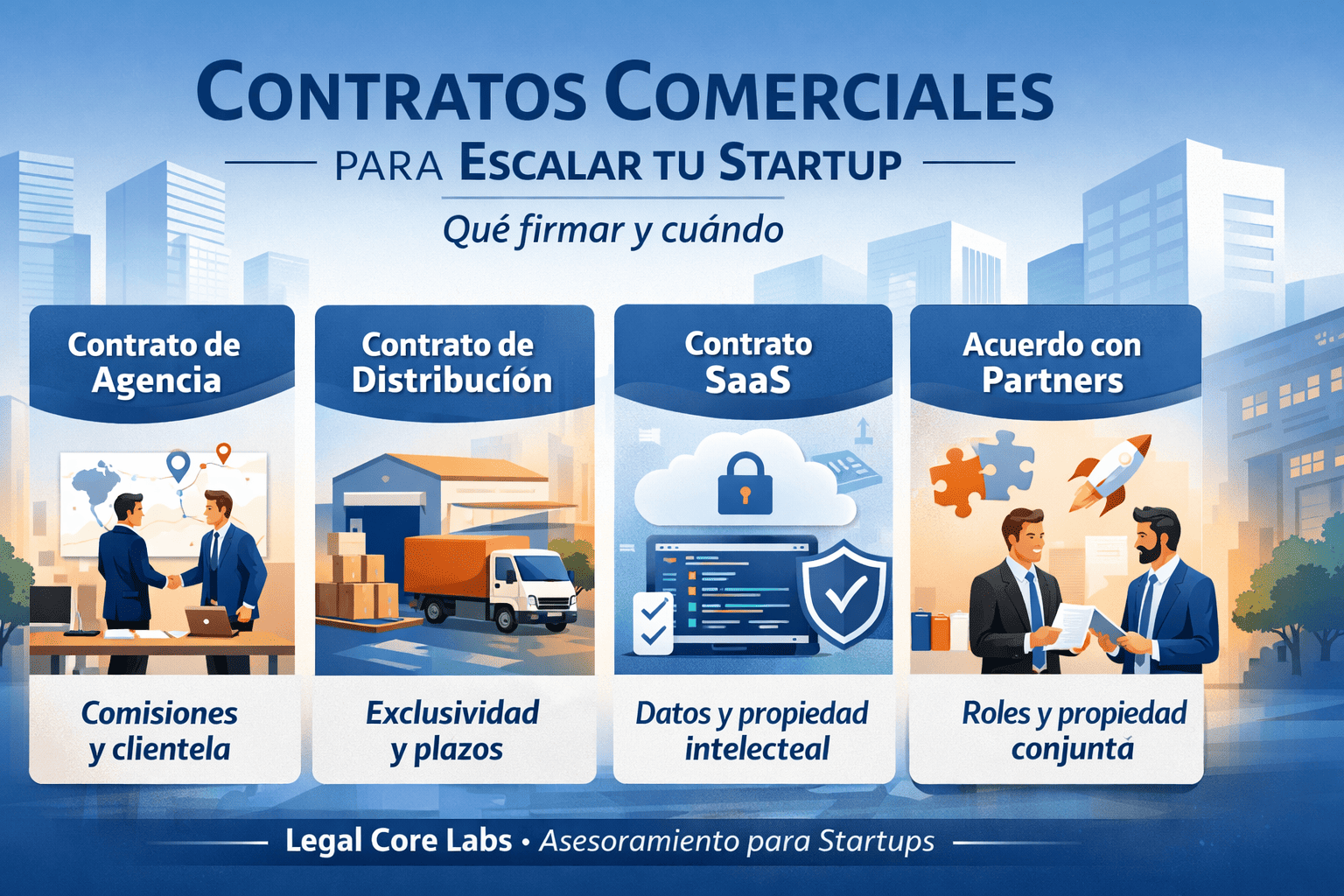
Essential commercial contracts to scale a startup: what to sign and when
When a startup begins to scale, attention usually shifts to sales, product development and fundraising. However, one critical element is often overlooked until problems arise: commercial contracts. In practice, many of the most serious conflicts during growth stages are not caused by the business model itself, but by poorly drafted, incomplete or non-existent agreements.
Scaling is not only about selling more. It also means structuring commercial relationships properly so that growth is sustainable and legally secure. In this article, we review the essential commercial contracts startups typically encounter, when they should be signed and which legal risk areas require special attention under Spanish and EU law.
Agency agreements: scaling sales without assuming excessive risk
Agency agreements are common when startups want to expand their sales network without building an internal commercial team. Under this model, the agent promotes sales on behalf of the company in exchange for a commission, without assuming the commercial risk of the transactions.
In Spain, agency agreements are regulated by Law 12/1992, which means contractual freedom is limited. One of the most sensitive issues is the customer goodwill indemnity, which may arise upon termination if the agent has brought new clients or significantly increased business volume. Many startups are unaware of this risk until the relationship ends.
Other key elements that must be clearly defined include territory, exclusivity, commission structure, duration and termination grounds. Ambiguity in these areas often leads to disputes once the business gains traction.
Distribution agreements: growth through third parties who assume commercial risk
Unlike agents, distributors purchase products or services and resell them at their own risk. This model is widely used by startups offering physical products or standardized solutions looking to expand quickly.
Distribution agreements are not specifically regulated under Spanish law, but that does not make them risk-free. On the contrary, what is agreed contractually becomes decisive. Common disputes arise from poorly defined exclusivity clauses, sales targets, contract duration and termination consequences.
A frequent mistake is using generic templates that do not reflect the startup’s actual business dynamics. This can result in claims related to abrupt termination, stock management or even agency-like indemnities if the relationship becomes economically dependent.
SaaS agreements: the legal backbone of digital business models
For tech startups, SaaS agreements are far more than standard commercial documents. They are a core legal pillar of the business, governing customer access, liability exposure and regulatory compliance.
From a legal standpoint, three areas require particular attention. First, intellectual property, ensuring that no ownership rights over the software are transferred, only a limited right of use. Second, liability and service levels, avoiding technical commitments that cannot realistically be guaranteed. Third, data protection, correctly defining GDPR roles and responsibilities under EU law.
Many startups begin with generic terms that fail to evolve alongside the product. This often becomes problematic when dealing with corporate clients, investors or significant service incidents.
Partnership agreements: collaborating without losing control
Partnership or collaboration agreements are common when startups rely on third parties for technology development, market access or joint ventures. Their flexibility is also their greatest risk.
Key friction points typically involve ownership of jointly developed results, brand usage rights, confidentiality and exit mechanisms. If these aspects are not clearly regulated, collaborations can easily turn into dependency relationships or disputes over ownership and exploitation rights.
A well-structured partnership agreement should regulate not only cooperation, but also its termination, allowing each party to continue independently without legal deadlocks.
When to sign and why delaying is a mistake
One of the most common startup errors is postponing contract formalization until the business “really works”. In reality, it is precisely the opposite: contracts enable the business to work and grow safely.
This does not mean signing overly complex agreements from day one. It means having contracts aligned with the current stage of the project, capable of evolving without generating legal uncertainty. Startups that structure their commercial relationships early gain speed, credibility and negotiating power.
Frequently asked questions
Which commercial contracts does a startup need to scale?
This depends on the business model, but agency agreements, distribution agreements, SaaS terms and partnership contracts are common. Poorly structured agreements often become growth bottlenecks or legal risks later on.
Are agency agreements required to be in writing in Spain?
Yes. Under Law 12/1992, either party may require the agreement to be formalized in writing, and the law establishes mandatory rights that startups must consider before signing.
What is the legal difference between an agent and a distributor?
Agents act as intermediaries and earn commissions, while distributors purchase and resell products at their own risk. This distinction has significant legal implications, especially regarding termination and compensation.
What should a SaaS agreement protect most carefully?
It must protect software intellectual property, properly limit liability, regulate service levels and comply with GDPR and EU data protection requirements.
Can startups use standard contract templates found online?
They can, but it is risky. Generic contracts rarely reflect the startup’s specific business model or Spanish and EU legal requirements, and usually fail in the most conflict-prone areas.
How Legal Core Labs can help
At Legal Core Labs, we help startups design, review and negotiate commercial contracts tailored to their business model and growth stage. Our approach combines legal rigor with practical insight, ensuring contracts support growth rather than slow it down.
Do you need to review your contracts before scaling? Legal Core Labs can help you do it right, with legal certainty and without unnecessary complexity.