Employee Expenses: How to Manage Them Correctly and Avoid Legal and Tax Risks
Salary vs. non-salary items and practical guidance for startups and tech SMEs in spain
Read more →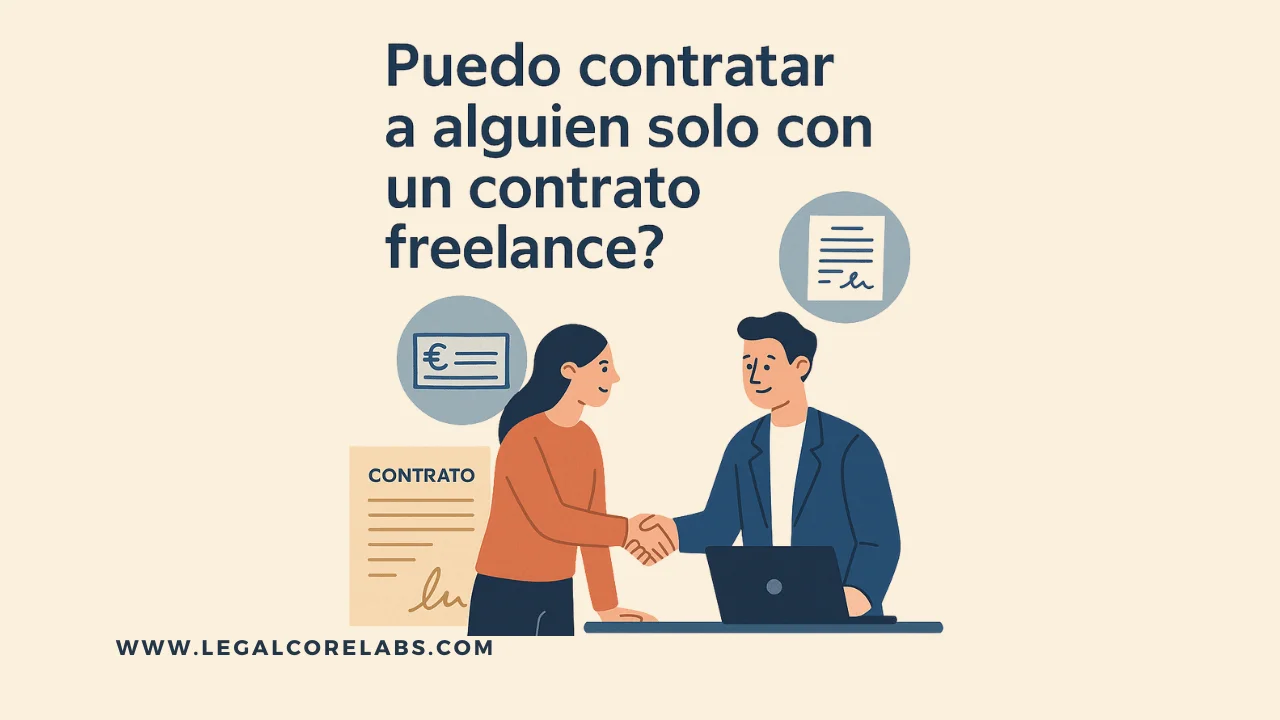
When a startup starts growing, the first impulse is usually to hire help in a flexible and cheap way. And it's common to think: "I'll make them a freelance contract, so I don't have to hire them on payroll or pay Social Security". Very common mistake... and very risky.
In this article we explain when you can hire with a freelance and when, even if you use that contract, you will be incurring in a disguised employment relationship. That is: a false self-employed person.
A freelance is an independent professional who provides services on their own account, with organizational autonomy and without being integrated into the client's structure. In Spain, they are normally registered as self-employed or through a single-person company.
Hiring a freelance doesn't mean signing a contract "off payroll" and that's it. For the contract to be valid, certain legal conditions must be met that distinguish it from an employment relationship. And this is where many startups make big mistakes.
The law is not based on the name of the contract, but on how the relationship behaves in practice. The key lies in these 4 elements that characterize an employment relationship according to the Workers' Statute:
Does the person follow your instructions, schedules, or is integrated into your team as if they were one more? Then they are a worker, not a freelance.
Do you (company) assume the business risk, and the person gets paid regardless of how things turn out? That indicates an employment relationship.
Do you pay a fixed amount each month, without variation, and without linking it to the result? Another indication of employment.
Can only that person do the work, and cannot freely delegate or subcontract it? It's another sign that we're dealing with an employee.
If these elements are present, it doesn't matter how you've titled the contract: if there's an inspection or the freelance sues claiming employment status, the relationship will be considered employment. And the consequences can be VERY SERIOUS.
The Labor Inspectorate can:
Additionally, if there's dismissal, the freelance could sue judicially as if they were a worker: compensation, unused vacation, salary differences, etc.
Using a service provision contract with a freelance is completely legal if:
In these cases, it's ideal to document everything in a well-drafted service provision contract, with:
And exclude any element that could imply a disguised employment relationship in the contract.
From Legal Core Labs we can help you:
Avoid mistakes that can be expensive. We advise you so you can grow with legal security and without surprises.
Salary vs. non-salary items and practical guidance for startups and tech SMEs in spain
Read more →
We analyze whether it is possible in Spain to dismiss an employee for low performance detected through artificial intelligence. Legal limits, requirements, and the real role of AI under the Workers’ Statute.
Read more →