
In this article
- 1. Key differences between self-employed and Limited Company
- 2. When is it advisable to start as self-employed?
- 3. What advantages does a Limited Company offer?
- 4. Comparative analysis: factors to consider before deciding
- 5. What if I’m the only founder? SLU and ERL as alternatives
- 6. What if I want to attract investment or build a startup?
- Conclusion: your legal form should align with your strategy
- Do you need legal advice to set up your business?
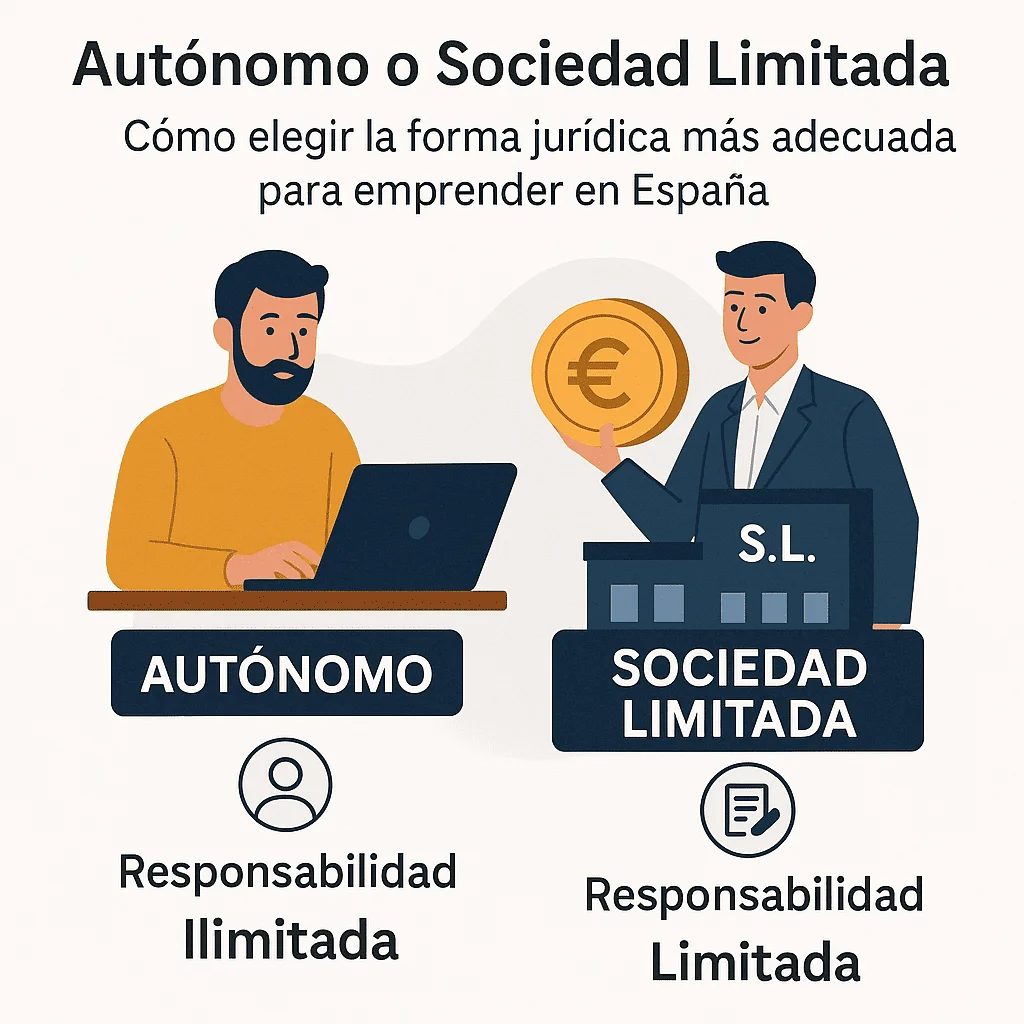
One of the first legal dilemmas faced by anyone starting a business in Spain is the legal form: should you start as a freelancer (autónomo) or incorporate a company, usually a Limited Liability Company (Sociedad Limitada – SL)?
The answer is not universal. There is no single “better” option, but there is always a more suitable legal structure depending on your type of activity, expected revenue, level of risk, financing needs, or growth projection.
In this article, we’ll help you make an informed decision by analyzing — from a legal and strategic perspective — the key differences between operating as a self-employed professional or through a company.
1. Key differences between self-employed and Limited Company
The main distinction between both figures is not only in name, but in legal structure and practical consequences.
Aspect | Sole Trader (Autónomo) | Limited Liability Company (SL) |
|---|---|---|
Legal personality | Natural person | Legal entity |
Liability | Unlimited | Limited to contributed capital |
Incorporation | Fast, no notary required | Public deed and Mercantile Registry |
Taxation | Progressive personal income tax (IRPF) | Corporate Tax (IS) |
Business image | Limited | Professional and corporate |
Financing | Difficult without personal guarantee | Greater access and perceived solvency |
Operating costs | Lower | Higher |
2. When is it advisable to start as self-employed?
Starting as self-employed is, in most cases, the most logical option when:
- It is a one-person initiative with low financial risk.
- No significant revenue is expected in the short term.
- You want to start immediately with minimal costs.
- A corporate image or bank financing is not required.
From a practical perspective, registering as self-employed is an administrative process that can be completed in 24 hours. It only requires registration with the Tax Agency (Hacienda) and the Special Regime for Self-Employed Workers (RETA). No public deed, minimum capital, or specialized legal assistance is required for incorporation.
Additionally, if you meet the requirements, you can benefit from the flat-rate contribution of €80 per month during the first year, which significantly reduces initial costs.
3. What advantages does a Limited Company offer?
Although forming an SL involves greater complexity, it also opens new opportunities worth considering if:
- Your business involves significant financial or contractual risk.
- You expect medium to high or scalable revenue.
- You plan to bring in partners or employees from the start.
- You need bank or external financing.
- You want to project a stronger and more professional image to clients and investors.
An SL allows you to separate your personal and business assets. In principle, you are only liable for company debts up to the capital contributed. This provides legal protection that self-employed individuals do not have.
Furthermore, since an SL is taxed under the Corporate Tax (Impuesto sobre Sociedades) regime, it allows better fiscal optimization when reinvesting profits, especially if you do not intend to withdraw all profits as personal income.
4. Comparative analysis: factors to consider before deciding
a) Liability
- Self-employed: personally liable for all debts, without limit.
- SL: partners only risk their contributed capital (except in cases of guarantees, negligence, or fraud).
💡 If your business involves signing contracts, assuming supplier or employment risks, or taking on debt, limiting your liability can make a major difference.
b) Incorporation and management costs
- Self-employed: no notary or registration fees — only administrative registration.
- SL: public deed, bylaws, and registration in the Mercantile Registry. Although the minimum legal capital is only €1, incorporation involves notarial fees, taxes, and registration costs (ITPAJD, if applicable).
As for ongoing costs:
- Self-employed workers file simpler quarterly returns and can manage with an affordable accountant.
- SLs require formal accounting, annual filings, corporate books, and more complex periodic reporting.
c) Taxation and planning
- IRPF (self-employed): progressive up to 47% for higher income brackets.
- Corporate Tax (SL): general rate of 25%; reduced rate of 15% during the first two years with positive taxable income (under certain conditions).
🔎 Important: if you start as self-employed and, within a year, create an SL continuing the same activity in which you hold more than 50%, you cannot benefit from the reduced 15% rate, according to the Corporate Tax Law.
d) Image, trust, and scalability
In certain sectors (consulting, B2B services, technology, etc.), operating as a company conveys a stronger and more structured image. In addition:
- Clients may require you to be an SL to sign contracts or participate in tenders.
- Suppliers value being able to review your corporate and financial information.
- Investors, business angels, or strategic partners are unlikely to invest in an informal self-employed venture.
e) Financing
Although banks often require a personal guarantee in both cases, an SL is generally better positioned to obtain credit:
- Companies present auditable financial statements.
- Their legal form provides clear capital structure.
- They project continuity and professionalism.
5. What if I’m the only founder? SLU and ERL as alternatives
a) Single-Member Limited Company (SLU)
An SL with a single shareholder. It has the same obligations as a standard SL but must explicitly declare its single-member status. Failure to do so can expose you to personal liability as if you were self-employed.
It is ideal for individuals who want to separate personal and business assets from the outset and do not plan to add partners in the short term.
b) Limited Liability Entrepreneur (ERL)
A figure introduced to allow self-employed individuals to protect their primary residence from business debts. However:
- Only one home can be protected, and within limits (€300,000, or €450,000 in large cities).
- The declaration must be registered in both the Mercantile and Property Registries.
- It does not exempt you from tax obligations or other potential liabilities.
Although it provides an intermediate solution, its practical application remains limited and does not replace the comprehensive protection offered by an SL.
6. What if I want to attract investment or build a startup?
If your business model is innovative and meets the requirements to be certified as a startup by ENISA, you must incorporate a company, as this type of certification is not granted to individual entrepreneurs.
Moreover, many public grants, accelerators, and private investors directly exclude activities without their own legal personality.
Conclusion: your legal form should align with your strategy
If you want… | Then the best option is… |
|---|---|
Agility, low cost, minimal obligations | Self-employed |
To separate personal and business assets | SL or SLU |
To grow with partners or attract investors | SL |
To minimize tax on reinvested profits | SL |
To validate an idea with low risk | Self-employed |
Do you need legal advice to set up your business?
At Legal Core Labs, we help you make the right decision from both a legal and strategic standpoint. We guide you through every step: from self-employed registration to company formation, shareholder agreements, and administrative filings.
- Personalized legal guidance.
- 100% online service with no hidden clauses.
- Specialists in corporate and tax law.
Turn your idea into a solid structure. Contact us today.