
In this article
In recent years, the advance of artificial intelligence has completely changed the way companies organize their activity. Digitalization is no longer a medium-term project, but an immediate necessity to ensure business continuity. In this new scenario, companies find themselves at a point where adapting to these tools not only improves internal processes, but is essential to maintaining their position in the market.
In this transformation, the role of workers is essential. Individual and collective productivity directly affects company performance and its ability to achieve its objectives. As a result, alongside tools that facilitate day-to-day work, others have emerged that allow performance to be measured more precisely, deviations to be identified, problems to be anticipated, and organizational measures to be adopted at the right time.
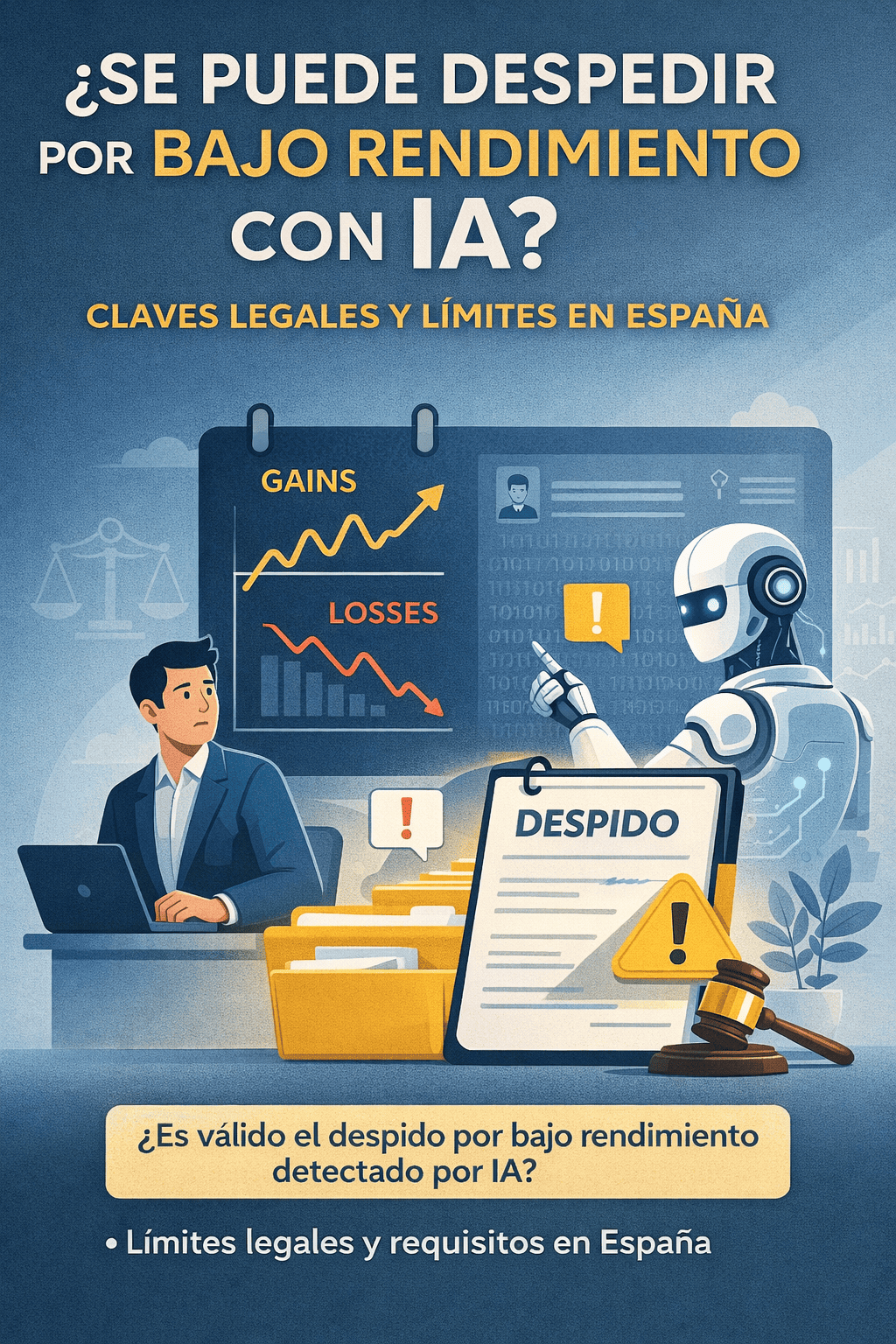
However, this analytical capacity raises several questions: what happens when data shows a drop in an employee’s performance? To what extent can companies rely on automated systems to identify these situations? And above all, is it possible in Spain to talk about dismissal for low performance based on artificial intelligence? Does an “automated dismissal” exist, and is it legally viable?
From this point onward, we will analyze what is meant by low performance, how it is approached from a legal perspective, and what real role artificial intelligence can play in these decisions.
1. Limits on the Employer’s Disciplinary Power
Before addressing low performance and the role AI may play, it is essential to recall that the employer’s disciplinary power exists, but it is not unlimited. It forms part of the employer’s managerial authority, but it is subject to clear rules.
Connection with the Employment Relationship
The sanctioned conduct must be related to the employment relationship. Disciplinary power can only be exercised with respect to facts that affect the employee’s professional obligations. What occurs outside work generally falls outside this scope, unless there is a direct connection with the company’s interests.
Typification of Offenses and Sanctions
Offenses and sanctions must be typified. The Workers’ Statute and collective bargaining agreements establish which behaviors are sanctionable and which sanctions apply. The company cannot sanction conduct or impose penalties that are not provided for in the applicable regulations.
Prohibition of Double Sanction (Non Bis In Idem)
It is not possible to sanction the same facts twice. Even if the same conduct appears in different reports, metrics, or records, once it has been sanctioned (for example, with a suspension of employment and salary), the company cannot impose a new sanction based on the same facts.
Legal Prohibitions on Sanctions
The law prohibits certain sanctions, such as wage fines or reductions in vacation time. Nor is it permissible to use incentive or productivity systems as a disguised sanction.
Proportionality
The sanction must be proportionate. Only serious and culpable breaches can justify disciplinary dismissal. In terms of performance, a one-off drop is not sufficient. A prolonged, relevant, previously warned and culpable reduction may justify dismissal, provided it is properly documented.
Good Faith in the Exercise of Disciplinary Power
The company must act consistently and in good faith. It cannot tolerate certain practices for long periods and then suddenly sanction them as serious misconduct. The same applies when new technological tools are implemented: an unknown or previously unexplained performance standard cannot be suddenly imposed on the employee.
Respect for Fundamental Rights
Disciplinary power cannot infringe fundamental rights. Any sanction adopted as retaliation or through intrusive or disproportionate mechanisms will be null and void. The use of AI systems to assess performance must pass this same test.
In addition, all disciplinary sanctions are subject to judicial review. Courts will examine whether the conduct existed, whether it was correctly classified, whether legal requirements were met, and whether the sanction imposed was proportionate.
2. Disciplinary Dismissal for Low Performance
Once the general limits of disciplinary power have been outlined, it is necessary to examine what is legally understood as a “continued and voluntary reduction in performance” and under what conditions it may justify disciplinary dismissal.
a) Existence of an Enforceable Performance Standard (Normal or Agreed)
The starting point is to determine the level of performance that can be required of the employee. This standard may be established through:
- The applicable collective bargaining agreement
- The employment contract
- Sector or company practices and customs
- Organizational systems implemented by the employer, provided they are reasonable and known to the workforce
Without a clear, verifiable, and reasonable benchmark, a disciplinary dismissal for low performance will hardly succeed, as it is not possible to determine precisely what was required and what has not been met.
b) Homogeneous Comparison and Proof of the Reduction
Low performance must be proven objectively, measurably, and reliably. Generic statements or subjective assessments are insufficient.
The comparison may be made:
- With the employee’s own previous performance
- With that of colleagues performing identical tasks under comparable conditions
It must be shown that the current performance is significantly lower than what could reasonably be expected, and that this difference is neither anecdotal nor the result of a temporary fluctuation.
c) Voluntariness and Fault
Low performance is only sanctionable when the reduction is due to voluntary or negligent behavior by the employee, not when it results from causes beyond their control.
There is no disciplinary low performance when the cause lies in:
- Lack of aptitude
- Technical changes the employee cannot follow
- Lack of adequate resources
- Illness or temporary incapacity
- External or market-related factors
Courts may presume voluntariness when there is a clear standard, adequate means, and no justified cause for the decline.
d) Continuity of the Reduction in Performance
A single drop, isolated error, or a bad week is not enough.
For disciplinary dismissal to be justified, the reduction must be:
- Persistent
- Prolonged over time
- Clearly appreciable over a reasonable observation period
Comparisons based on very short timeframes or insufficient observation periods do not meet this requirement.
e) Burden of Proof and Specificity of the Dismissal Letter
The burden of proof lies entirely with the employer, who must:
- Provide objective data, figures, or reports showing the reduction
- Specify the facts, periods, and comparison parameters used
- Explain why the performance constitutes a serious and culpable breach
If the dismissal letter does not detail these essential elements, the dismissal will be deemed unfair due to lack of specificity, regardless of what may later be proven in court.
f) Employee’s Right of Defense
Once the reduction is alleged, the employee may justify it by demonstrating causes not attributable to their behavior, such as organizational problems, changes in workload, technical incidents, market shifts, or justified personal circumstances.
If a reasonable cause exists that is beyond the employee’s control, the disciplinary classification fails.
Conclusion
Artificial intelligence offers new possibilities for measuring and analyzing performance, but it does not alter the existing legal framework governing disciplinary power. Disciplinary dismissal for low performance remains subject to the same legal, evidentiary, and guarantee-based requirements.
The key question is no longer only how to measure performance, but how to integrate these technological tools without exceeding legal limits and while ensuring respect for workers’ rights. This debate remains open and will continue to be shaped by future court decisions on the use of AI in the workplace.